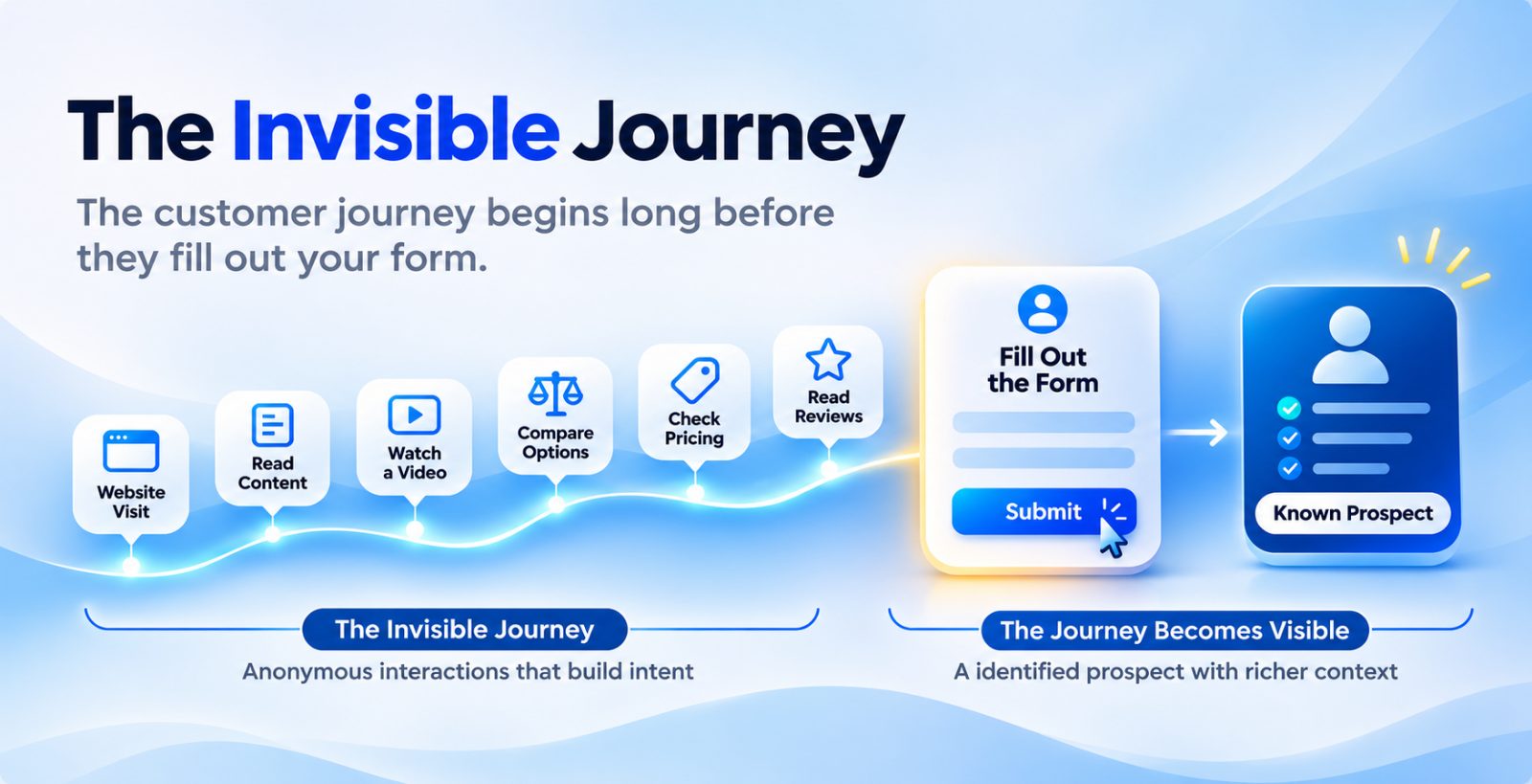
It may have started weeks before you knew the customer existed.
A prospect fills out a form on your website.
A notification appears.
Someone from sales calls.
The CRM creates a record.
And everyone says:
“We have a new lead.”
But let's pause for a moment.
Was that really the beginning of the customer's journey?
Probably not.
By the time that form was submitted, the person may already have:
- Visited your website several times.
- Read your product pages.
- Compared your offering with competitors.
- Watched a video.
- Read customer reviews.
- Checked your pricing.
- Shared your website with a colleague.
- Left without taking any action.
- Returned a few days later.
The form didn't start the journey.
It simply made the journey visible to you.
And those are two very different things.
The Part of the Journey Businesses Don't See
This is one of the most interesting challenges in modern marketing.
Businesses have become very good at tracking known customers.
Once someone submits a form, makes a purchase, calls the business, or identifies themselves, there is usually a record.
But what happens before that?
That's where things become less clear.
A visitor arrives at your website.
Looks at three pages.
Leaves.
Returns two days later.
Reads a case study.
Leaves again.
Comes back through a search engine.
Checks pricing.
Still doesn't enquire.
From the customer's perspective, that's a journey.
From the business's perspective, it may simply look like:
Website visitor.
And that missing context can matter enormously.
The Invisible Journey
I call this the Invisible Journey.
It is the part of the customer's journey that happens before the business can confidently connect the activity to a person.
The customer is already researching.
Comparing.
Evaluating.
Forming opinions.
Building trust.
But the business doesn't yet have a complete picture.
This creates an interesting imbalance.
The customer may know a great deal about the business before the business knows anything meaningful about the customer.
They may have read your content.
Studied your offering.
Compared your pricing.
Looked at alternatives.
And yet, when they finally fill out a form, the business often treats them as if the relationship has just begun.
The Form Can Hide More Than It Reveals
Forms are useful.
They help businesses identify prospects.
But imagine a prospect submits this:
- Name: Rahul
- Company: ABC Industries
- Email: rahul@abc.com
- Phone: +91 XXXXX XXXXX
That's what the form tells you.
But what if, before submitting it, Rahul had:
- visited your website four times,
- spent significant time reading one particular solution page,
- downloaded an industry report,
- returned after receiving an email,
- and spent ten minutes researching your pricing?
That context tells a much richer story.
The difference isn't simply more data.
It's more understanding.
When Sales Receives the Lead, What Do They Really Know?
This is where the gap becomes operational.
A lead reaches sales.
The salesperson sees:
New Lead: ABC Industries
They may know the form details.
But do they know what brought Rahul there?
What did he read?
What did he compare?
What seemed to interest him?
What questions did he appear to be exploring?
What happened before he raised his hand?
Without that context, the first sales conversation often starts from zero.
And customers don't always appreciate starting from zero.
They may have spent weeks researching you.
The salesperson may have only just met them.
Context Changes Conversations
Compare these two sales conversations.
Conversation A
“Hi Rahul, thanks for your enquiry. Can I understand what you're looking for?”
Nothing wrong with that.
But it's a blank page.
Conversation B
“I noticed you've been exploring our solutions for manufacturing businesses. I thought the implementation guide you looked at might have raised a few questions. What are you trying to solve right now?”
That's different.
The second conversation begins with context.
It doesn't mean the salesperson should make assumptions.
It means they can begin with a more informed question.
Context doesn't replace conversation. It improves it.
The Real Customer Journey Is Bigger Than the CRM
This is an uncomfortable thought for many organisations.
The CRM is often treated as the source of truth for the customer journey.
But a CRM usually becomes most useful once the customer becomes identifiable.
The customer's journey doesn't necessarily wait for that moment.
It happens across:
- Website.
- Search.
- Content.
- Social media.
- Email.
- Messaging.
- Sales conversations.
- Support.
- Purchases.
- Reviews.
- Referrals.
The customer experiences these as one journey.
Businesses often experience them as separate systems.
That's where context gets lost.
The Journey Gap
This creates another useful question for leadership teams:
How much of the customer journey can we actually see?
You may know exactly what happens after a lead is created.
But how much do you know about what happened before?
You may know when a customer purchased.
But do you know what convinced them?
You may know when a customer left.
But do you know when their relationship with you started weakening?
The bigger the gap between the customer's actual journey and the journey the business can see, the harder it becomes to make intelligent decisions.
What Should Leaders Be Looking For?
You don't necessarily need more dashboards.
Start with better questions.
Ask:
- When does our customer's journey actually begin?
- What can we see before a prospect identifies themselves?
- What context does sales receive when a prospect becomes known?
- Can we connect interactions across different channels into one story?
- Where are we losing context between marketing, sales and customer success?
These questions can reveal more than another campaign report.
The Goal Isn't to Track Everything
This is important.
Customer intelligence isn't about watching every click simply because technology allows it.
The objective is not surveillance.
The objective is understanding.
A business should be able to answer:
“What is this customer trying to accomplish, and what have we learned from their journey so far?”
That is useful information.
Anything beyond that should have a purpose.
Executive Reflection
Before your next customer journey review, ask your leadership team:
- When does our customer journey actually begin?
- What do we know about a prospect before they become a lead?
- When a sales team receives a new lead, how much context do they receive along with the contact details?
If the answer to the second and third questions is “not much,” there may be a significant part of your customer journey that is happening in the dark.
Closing Thought
A customer doesn't become interested in your business the moment they fill out a form.
They may have been thinking about you for days.
Sometimes weeks.
Sometimes months.
The form simply tells you:
“I'm ready to be known.”
The real opportunity is to understand what happened before that moment.
Because the more complete the journey you can see, the better the conversation you can have.
And better conversations are where better customer relationships begin.
Executive Insights | EI-008 | Plumb5